
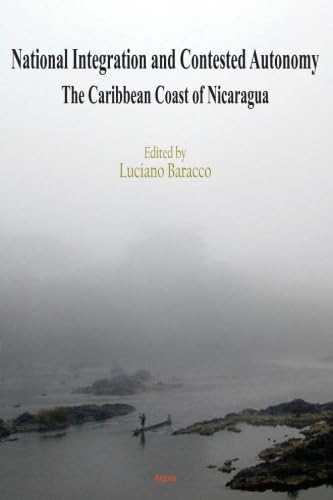
National Integration and Contested Autonomy: The Caribbean Coast of Nicaragua
Product details
| Management number | 233453118 | Release Date | 2026/06/27 | List Price | $8.35 | Model Number | 233453118 | ||
|---|---|---|---|---|---|---|---|---|---|
| Category | |||||||||
In National Integration and Contested Autonomy, Luciano Baracco (ed.) presents a stirring narrative of resilience, identity, and political struggle that continues to shape Nicaragua’s modern history. The indigenous and Afro-descendant peoples along Nicaragua's Caribbean Coast, once colonized by the British, have long sought to establish their autonomy vis-a-vis the dominant Spanish-influenced regions of the Pacific coast.The chapters, each written by an expert in the field, outline the historical, political, and social dynamics shaping the contested autonomy of Nicaragua’s Caribbean Coast including claims to land, language rights, and land demarcation and communal forestry projects. The author also examines the tensions involved in region’s struggle for self-determination while navigating the complexities of national integration in a multi-ethnic society.Historical Roots of Autonomy:Baracco traces the historical context of Nicaragua’s Caribbean Coast, focusing on colonial legacies, indigenous resistance, and the region’s unique cultural identity. He explains how these historical forces laid the foundation for political struggles that persist today, highlighting how marginalized communities fought to preserve their cultural heritage and secure political representation.Conflict and Integration:The book explores the intersection of indigenous rights, national sovereignty, and international politics. Baracco discusses key moments in the region's history, including armed conflicts, peace accords, and constitutional reforms aimed at balancing national integration with local autonomy. Through these narratives, he sheds light on the continuous power struggle between central authorities and local communities.Multicultural Politics and Social Movements:Baracco emphasizes the role of social movements, indigenous organizations, and grassroots leaders advocating for autonomy. He highlights their successes and setbacks, demonstrating how local activism has shaped national policy while confronting state-driven development projects that often disregard indigenous rights and environmental concerns.Implications for Policy and Governance:Providing a critical perspective on decentralization and multicultural governance, the book evaluates policy efforts aimed at fostering social cohesion while respecting cultural diversity. Baracco’s in-depth analysis calls for more inclusive and equitable political frameworks to ensure long-term stability and mutual respect.Scholars of Latin American studies, political science, and indigenous rights advocacy will find the facts and arguments useful in their work. The book offers valuable insights into the challenges of integrating diverse populations within a unified national framework while respecting cultural autonomy—a pressing issue in many multi-ethnic states today Read more
| ISBN10 | 0875868223 |
|---|---|
| ISBN13 | 978-0875868226 |
| Language | English |
| Publisher | Algora Publishing |
| Dimensions | 6 x 0.9 x 9 inches |
| Item Weight | 1.05 pounds |
| Print length | 358 pages |
| Publication date | January 19, 2011 |

Bestseller ranking
Nicaragua




Customers who viewed this product also viewed
Alpine Touring Skin Accessories


Correction of product information
If you notice any omissions or errors in the product information on this page, please use the correction request form below.
Correction Request Form